CONTENT GENERATION
An example of how I turn a manual content process into one connected AI pipeline.
An AI-powered content automation system that transforms ideas into social media content, visual assets, videos, and publishing-ready outputs.
Process snapshot
Illustrative view of how this system is structured — workflow characteristics, not measured client results.
- Workflow screenshots
- 03
- Core technologies
- 06
- Content pipeline
- Multi-stage
Workflow screenshots
Core technologies
Content pipeline
Automation coverage by stage
- 01
A schedule or idea input starts the workflow and pulls the source content
- 02
AI models create the scenes and written content for each piece
- 03
Image prompts are generated from that content
- 04
Images are produced, including close-up and winner variations
Bars indicate how far each stage runs without manual input — illustrative, not measured.
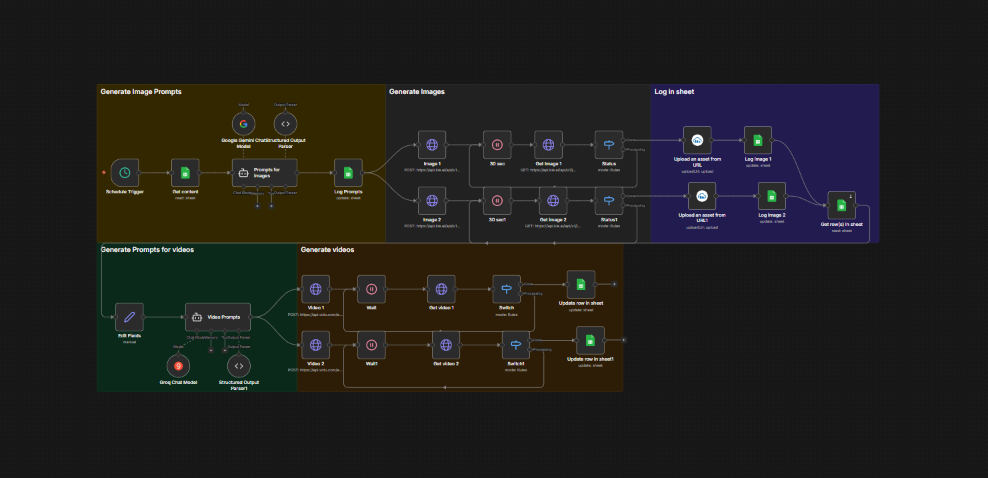
Overview
The system automates the stages of content production that normally happen across several disconnected tools: writing the content, describing the visuals, generating the assets, producing video and preparing everything for publishing.
Each stage is an explicit part of an n8n workflow, so the output of one step becomes the structured input of the next instead of being copied by hand.
The challenge
Producing content consistently means jumping between writing tools, image generators, video tools and spreadsheets, and moving every asset by hand between them.
The solution
A single orchestrated workflow where each stage hands structured output to the next — from idea and copy through visuals and video to publishing-ready records.
How it works
- 01A schedule or idea input starts the workflow and pulls the source content
- 02AI models create the scenes and written content for each piece
- 03Image prompts are generated from that content
- 04Images are produced, including close-up and winner variations
- 05Video prompts are generated and passed to video generation
- 06Rendered outputs and prompts are logged into Google Sheets
- 07Finished content is moved toward the publishing destinations
Automation & architecture
Carousel content pipeline with structured output parsing. Each component is wired so data passes forward in a predictable shape, with the AI layer making the decisions and the automation layer carrying out the actions.
- Creating content and scenes
- Generating image prompts
- Generating visual assets
- Creating close-up and winner images
- Generating video prompts
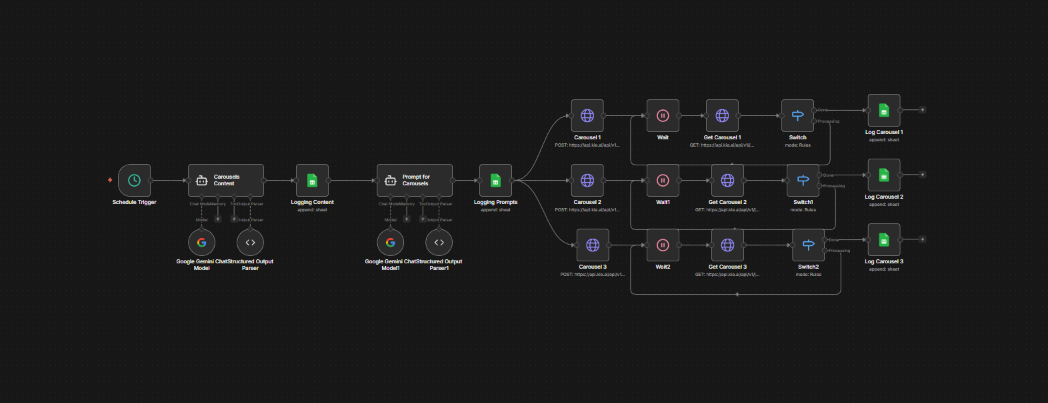
More from this system
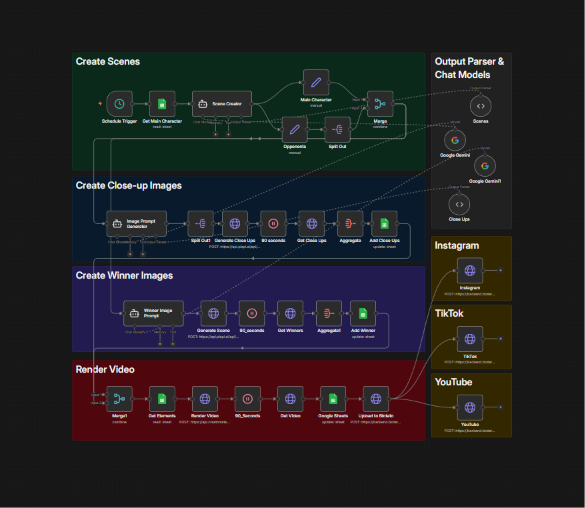
What it automates
- Writing content and scene breakdowns
- Turning content into image prompts
- Generating images, including close-up and winner variations
- Generating video prompts and rendering video
- Logging prompts and outputs into Google Sheets
- Preparing finished content for publishing
My role
Designed and built the complete AI-powered content automation pipeline.
Benefits
- Reduces repetitive content-production work
- Connects multiple AI generation steps into one pipeline
- Removes manual movement of assets between tools
- Gives the content workflow a clear, structured shape
- Makes content production repeatable
- Moves content toward publishing with less manual intervention
Have a process worth automating?
These are examples of systems I've designed — the approach adapts to most business workflows.